
The Badge Inflation Era
“Verified” used to be a blunt instrument: a platform saying, “we did some work to confirm this is who you think it is.”
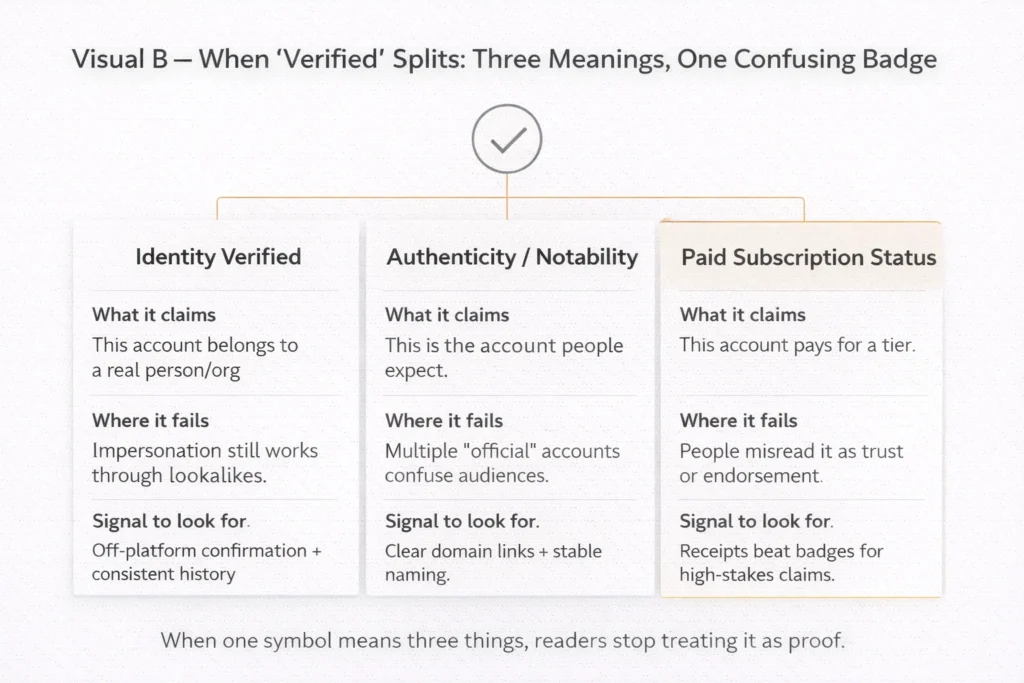
Then platforms expanded what the badge can mean. In some places, it now signals identity checks. In others, it signals paid subscription status. In others, it signals “notability,” which is closer to public-interest routing than identity.
When one symbol carries multiple meanings, it stops being evidence. It becomes UI.
X’s verified policy (what the badge means today)
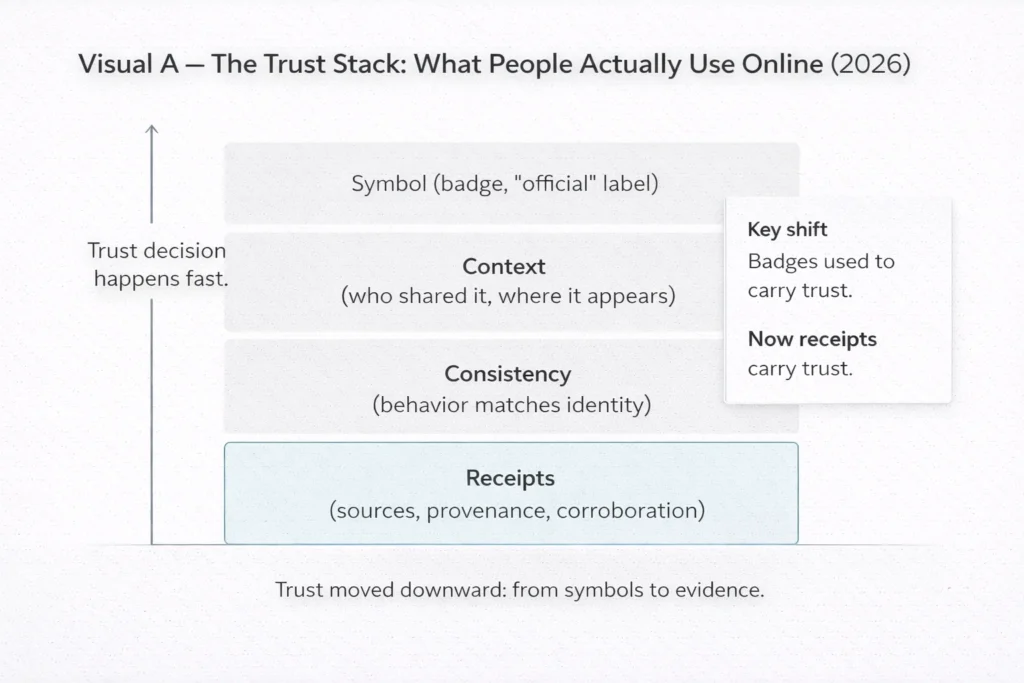
Trust Isn’t a Label. It’s a Chain.
The internet’s trust problem isn’t that people are “too online.” It’s that we keep trying to compress hard questions into a single icon.
Trust is usually a chain:
- Who is this? (identity)
- Should I expect this account to speak for that person/org? (authenticity)
- Is this claim backed by primary evidence I can check? (verifiability)
- Is someone accountable if it’s wrong? (liability + enforcement)
A “verified” badge can touch the first two. It can’t do the last two. And the last two are what matter when stakes rise.
NIST digital identity guidance (identity proofing ≠ trustworthiness)
Three Things People Confuse (And Platforms Don’t Always Clarify)
1) Identity verified
Identity proofing is about linking an account to a real entity with some level of assurance. It can reduce random impersonation. It does not prevent motivated impersonation (lookalike names, stolen documents, compromised accounts) and it doesn’t validate content.
NIST SP 800-63 (assurance levels + limits)
Real-World Context: Paid verification products pushed identity checks into a consumer subscription. That changes incentives: platforms want scale; scammers want legitimacy. When those goals collide, the badge becomes a target.
2) Authenticity / “the account you expect”
This is the “is this the official one?” question. Notability verification once tried to answer it, imperfectly. Now the same question is often answered by a messy combination of: badge + follower count + search ranking + what other people quote.
And yes—multiple “official” accounts exist. Some are regional. Some are legacy. Some are managed by agencies. Some are fake but persistent.
X’s explanation of verified accounts and labels
Real-World Context: When a crisis hits (election day, war footage, breaking court news), the audience doesn’t calmly check domain records. They pattern-match. A badge accelerates pattern-matching—for good and bad.
3) Paid subscription status
A paid tier can buy visibility features, distribution perks, or cosmetic signaling. None of that equals “trusted.” The badge becomes a status marker, not a truth marker.
Meta Verified overview (paid verification product)
Real-World Context: Meta Verified and X Premium are not trying to be courts of truth. They’re trying to reduce impersonation and monetize. Those are legitimate business goals. They’re just not the same thing as “this is reliable.”
How “Verified” Breaks in the Real World
Here are four common failure modes I see repeatedly:
Failure mode 1: Lookalike impersonation still works
Bad actors don’t need to defeat verification if they can exploit human attention: similar names, similar profile photos, similar bios, and timing. The badge becomes one more prop.
X policy context (verified ≠ content verification)
Failure mode 2: The badge becomes an authority shortcut
There’s evidence that “verified” status can shift how audiences perceive credibility and influence—often regardless of actual content quality.
ACM paper on verified users and credibility signals
Failure mode 3: “Proof” gets swapped for polish
Verified accounts are more likely to be quoted, screenshotted, and repeated. That increases the payoff of polished misinformation: clean writing, confident tone, neatly formatted threads. It looks like authority. It spreads like authority.
EU Digital Services Act (systemic risk framing + transparency obligations for major platforms)
Failure mode 4: People mistake platform signals for endorsements
This is where confusion becomes costly. “Verified” can be misread as endorsement, partnership, or approval. Regulators have long cared about confusing signals in advertising and endorsements—because consumers predictably over-trust “official-looking” cues.
FTC Endorsement Guides (what must be disclosed, what can mislead)
The Trust Stack: What to Use Instead of the Badge
If you want something that survives contact with reality, use a trust stack—multiple checks that reinforce each other.
Layer 1: Provenance you can follow
Can you trace a claim back to a primary document, raw footage, court filing, dataset, official statement, or a direct recording? If not, downgrade confidence fast.
EU DSA text (transparency + systemic risk pressure on major platforms)
Real-World Context: This is why journalists and researchers keep pushing for citation norms in AI summaries and “answer boxes.” If users don’t see sources, they can’t audit. And if they can’t audit, “verified” becomes theater.
Layer 2: Cross-channel confirmation
If a person/org matters, they usually have at least one off-platform anchor: an official website domain, a verified press page, a public filings page, or a consistent set of references from reputable institutions.
NIST digital identity framing (identity proofing is narrow by design)
Real-World Context: The most reliable “verification” is boring: an official domain with consistent history, plus a long-lived track record across channels. That’s why scams often avoid domains and lean on social profiles.
Incentives: Why Platforms Let Confusion Persist
Confusion isn’t always an accident. Sometimes it’s a tradeoff.
Badges reduce some impersonation. They also create a product. Products need adoption. Adoption prefers simplicity. Simplicity prefers one symbol.
But the moment the badge becomes a product, it has a built-in tension: the platform wants the badge to be common enough to sell, while users want it to be rare enough to mean something.
That’s the badge inflation problem.
If you want the deeper “who checks the checkers?” angle, the right question isn’t “is this verified?” It’s “who audits the systems that produce trust signals?”
What “Verified” Should Mean (If We Were Serious)
Here’s the clean version platforms could adopt without pretending to solve truth:
- Verified identity = “We confirmed a real entity controls this account at a stated assurance level.”
- Verified authenticity = “This account is the canonical/public-facing account for that entity.”
- No claim about content = “We do not validate the truth of posts.”
The critical piece is disclosure. Not vibes. Not icons. Clear terms.
FTC endorsement guidance (why unclear signals mislead consumers)
If This Shift Continues, We Should See…
- Platforms splitting badges into distinct labels (identity vs paid vs official) rather than one overloaded icon.
- More “source required” UI in high-velocity contexts (breaking news, elections, crises).
- Regulators leaning harder on transparency duties for major platforms, especially around systemic risks and amplification.
- More lawsuits and policy fights over impersonation harm, fraud, and consumer deception tied to platform signals.
- Publishers pushing identity and authority back to domains, newsletters, and direct channels—because rented trust is unstable.
Digital Services Act text (risk + transparency pressure)
Real-World Context: Watch what platforms do during elections and market-moving events. That’s when “trust UI” gets stress-tested—and when quietly-changed rules suddenly matter.
The Minimum Responsible Standard (For Readers and Publishers)
Minimum Responsible Standard — “Verified” Online
Requirement 1: Badge meaning must be explicit (identity / official / subscription).
Requirement 2: High-stakes claims must include primary sources or be treated as unverified.
Requirement 3: Off-platform anchors (official domains, filings, institutional pages) should be preferred over platform icons.
Disclosure: Paid status must never be visually identical to identity verification.
Auditability: Platforms should publish enforcement and impersonation metrics in transparency reports
By Sami Hayes – AIchronicle Insights
Pingback: AI Answers Are Replacing Websites In Search