
The Quiet Dependency: Water Is the Real “Uptime” Constraint
AI feels weightless. You type a prompt, a model answers, and the whole thing looks like software.
But “uptime” is a physical promise. Servers draw power, power becomes heat, and heat must be removed—every minute, at scale.
In a lot of places, the limiting input isn’t GPUs. It isn’t even electricity. It’s whether you can reliably reject heat when it’s 95°F outside, while your local water system is stressed, regulated, or politically sensitive.
Data centers don’t “need” water in the same way people do. They need cooling. Water is one of the most effective and widely used ways to deliver it.
That’s why debates about AI growth keep drifting toward power plants and grid upgrades. The water story is quieter, but it’s often the one that gets a project delayed—or gets a community angry enough to force scrutiny.
If you want the baseline reality check: data centers are significant electricity consumers, and cooling is a major part of their operating profile, especially as compute density rises. IEA data centres and data transmission networks overview
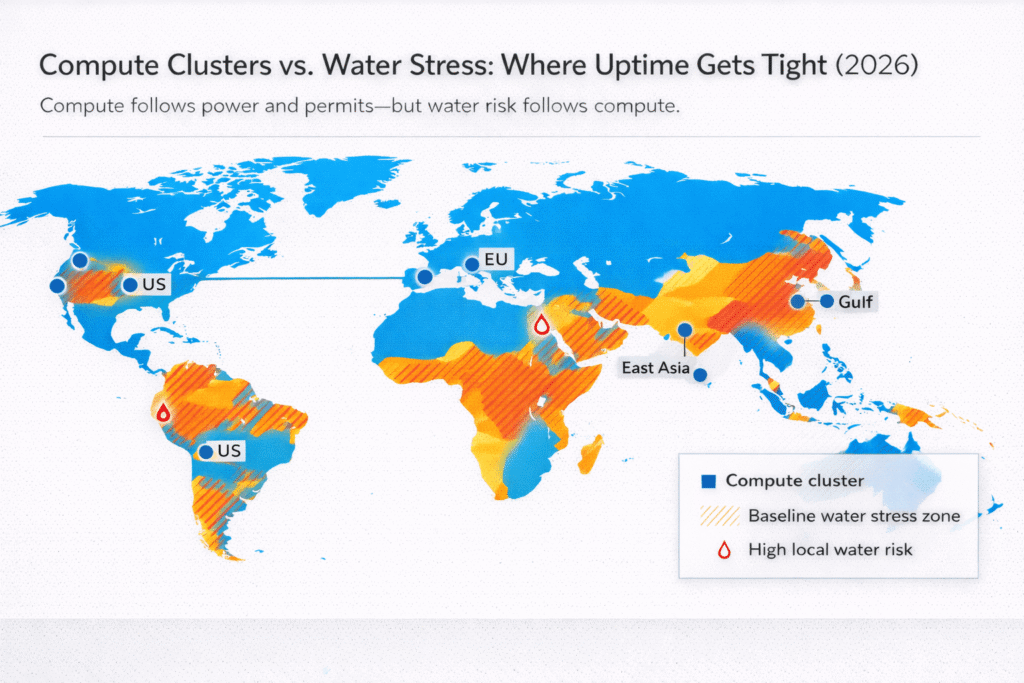
A Map You Don’t See: Where Compute Goes, Water Risk Follows
Data centers cluster for boring reasons that matter: power availability, fiber routes, latency, land, tax policy, and permitting timelines. When the economics work, you don’t get one facility—you get an ecosystem.
That clustering concentrates water risk. It also concentrates attention. Once a region is known as “data center country,” local utilities, planners, and residents start asking questions that don’t show up in cloud marketing: Where is the water coming from? What happens in drought years? What’s the contingency plan during heat waves?
Northern Virginia is the classic example of compute clustering: huge capacity, fast interconnects, relentless buildout. It’s also where water use has become a visible political issue, because growth is not abstract anymore—it shows up in local infrastructure planning. Financial Times reporting on data center buildout dynamics
https://www.ft.com/content/1d468bd2-6712-4cdd-ac71-21e0ace2d048
Then there are desert metros and drought-prone regions where the tension is sharper: new industrial demand showing up in places already negotiating scarcity. A Reuters deep dive on data centers and water stress in Phoenix captures the flavor of the conflict—growth incentives colliding with water realities. Reuters reporting on Phoenix data centers and water stress
If you want a global lens on “water risk follows compute,” the World Resources Institute’s Aqueduct mapping is the standard reference for baseline water stress context. WRI Aqueduct water risk maps
The Four Ways Data Centers “Use” Water (It’s Not Just Drinking Water)
1) Evaporation: The Disappearing Water You Can’t Reuse
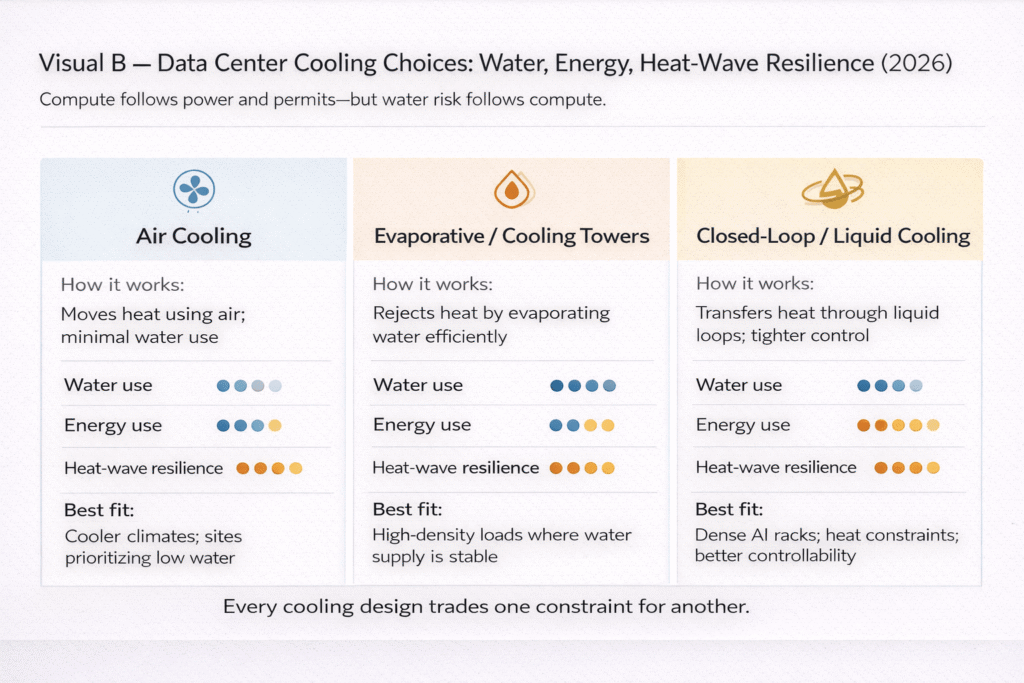
A big chunk of data center “water use” is really evaporation. In evaporative cooling systems (including cooling towers), water is used to reject heat by changing state—some of it literally leaves the system as vapor. That’s efficient for heat removal, but it means consumption can rise when it’s hottest and driest.
For an accessible engineering overview of why evaporative approaches show up in data centers (and the tradeoffs operators manage), U.S. Department of Energy data center resources
2) Heat Rejection: The Thermodynamics Nobody Votes On
Heat isn’t optional. Compute turns electricity into heat. Cooling is the act of moving that heat somewhere else. When ambient temperatures climb, cooling gets harder—and designs that look fine on mild days can get stressed during heat waves.
For background on cooling approaches and thermal management constraints, U.S. Department of Energy data center resources
3) Water Quality: Minerals, Corrosion, and Why “Any Water” Isn’t Enough
Operators don’t just ask “how much water?” They ask what kind. Mineral content, corrosion potential, biological growth, and treatment requirements affect reliability. That’s why some facilities explore reclaimed or non-potable sources—but those come with engineering limits and governance questions.
For U.S. water quality and treatment context, EPA drinking water and groundwater basics
4) Indirect Water: Power Generation’s Hidden Thirst
Here’s the part most people miss: even if a facility minimizes on-site water, the electricity supply chain can carry a water footprint depending on how power is generated and cooled. Thermoelectric power, in particular, has historically involved large water withdrawals, with consumption varying by technology and cooling approach.
For the baseline on U.S. water use categories, including thermoelectric, USGS water use in the United States
The Metric Problem: Why One Number Can Mislead
People love a single scoreboard number. That’s exactly the trap.
Water reporting depends on boundaries (what’s counted), geography (where it happens), and time (seasonality and heat events). If you compare two facilities using one headline figure without context, you can end up rewarding the wrong behavior.
A common metric discussed in the industry is Water Usage Effectiveness (WUE). It can be useful, but it’s also easy to misunderstand if you don’t know the scope and definitions. The Green Grid WUE metric background
For a formal standard reference, ISO/IEC publishes WUE as part of the data center KPI standards series (ISO/IEC 30134-9). ISO/IEC 30134-9 standard page
What “good disclosure” looks like is boring but powerful: define the boundary, name the cooling type, report region, show seasonal variation, and explain what is and isn’t included. Without that, WUE-style numbers become marketing shorthand instead of accountability.
When Water Politics Hits Compute: The Local Conflict Pattern
Pattern 1: New facility, old aquifer
A new data center proposal shows up in a place where the water system was designed for yesterday’s population and industry mix. The conflict isn’t “AI vs people.” It’s: what is the capital plan, and who pays for resilience? This is where utilities and local governments become the real gatekeepers. For baseline stress context, WRI Aqueduct water risk maps
Pattern 2: Drought year scrutiny
In a drought year, everything tightens—watering restrictions, public meetings, political optics. Even if a facility has permits, the social license can get fragile fast. For a concrete example of that pressure dynamic, Reuters reporting on Phoenix data centers and water stress
Pattern 3: Community trust gap
If operators won’t disclose basics—cooling approach, water sourcing strategy, contingency plans—people assume the worst. Sometimes they’re wrong. But secrecy is still a choice, and it has a predictable outcome: delays, hearings, and reputational friction.
This is also where the broader physical stack matters. See The physical world behind digital AI
What Operators Do When They’re Serious
Siting strategy:
Water risk is a location decision before it’s an engineering decision. Some regions make cooling easy and politics calm; others make both hard. For a grounding overview of why location, grid and cooling constraints increasingly interact, IEA data centers and data transmission networks overview
Cooling design:
There’s no free lunch: designs that reduce water use can increase energy use, and vice versa. For an engineering primer and efficiency pathways, U.S. Department of Energy data center resources
Water sourcing:
Using reclaimed or non-potable water can reduce competition with residential supply, but it requires infrastructure, treatment, and a governance story that communities accept. For reuse context, EPA water reuse overview
Heat-wave operations:
Heat waves are the stress test. If your plan is “we’ll just run harder,” you’ll learn quickly that cooling has limits. Planning for peak conditions is part of reliability engineering, not sustainability theater.
Transparency:
Operators that publish boundaries, region, seasonal variation, and methods earn credibility. Without that, every number looks like PR.
The Risk Transfer Question: Who Pays When Water Becomes Scarce?
Water scarcity is not just a technical constraint—it’s a governance problem. Somebody absorbs the risk when supply tightens. The only real questions are who, how, and whether it’s explicit or hidden.
Residents and municipal systems carry risk when industrial demand shows up faster than infrastructure expansion. Utilities carry risk when they’re forced to meet reliability expectations while balancing regulatory constraints. Regulators carry risk when permitting becomes a proxy battle over growth, land use, and resource allocation. Operators carry risk when they build in a region where water politics is already tense—because “we have a permit” isn’t the same as “we have trust.”
And customers—cloud buyers, enterprises, AI labs—often act like they’re insulated. They’re not. If water constraints force operational limits, those limits appear upstream as capacity delays, pricing pressure, or reliability incidents.
This is where environmental impact discussions connect across the stack. For the training-side pressure that feeds right back into siting and cooling, see The environmental cost of training large AI models
For a credible public baseline on water withdrawals and the sectors that dominate water use in the U.S., USGS water use in the United States
The Standard That Would Make This Less Messy
Minimum Water Transparency Standard — AI Infrastructure
Boundary: direct on-site water vs indirect (power-related) water
Source: potable / reclaimed / non-potable, with treatment assumptions
Cooling type: air / evaporative / closed-loop / liquid, plus fallback modes
Local context: basin stress indicator + utility capacity note
Seasonality: monthly or seasonal reporting, not a single annual average
Contingency plan: heat-wave + drought-year operating plan
Verification: method disclosure + third-party assurance if available
Community disclosure: publish the basics before the permitting fight forces it
By Sami Hayes — The AI Chronicle Insights
Pingback: Who Controls the Chips Controls AI’s Future
Pingback: The Physical World Behind Digital AI Infrastructure
Pingback: The Environmental Footprint of AI Image and Video Generation