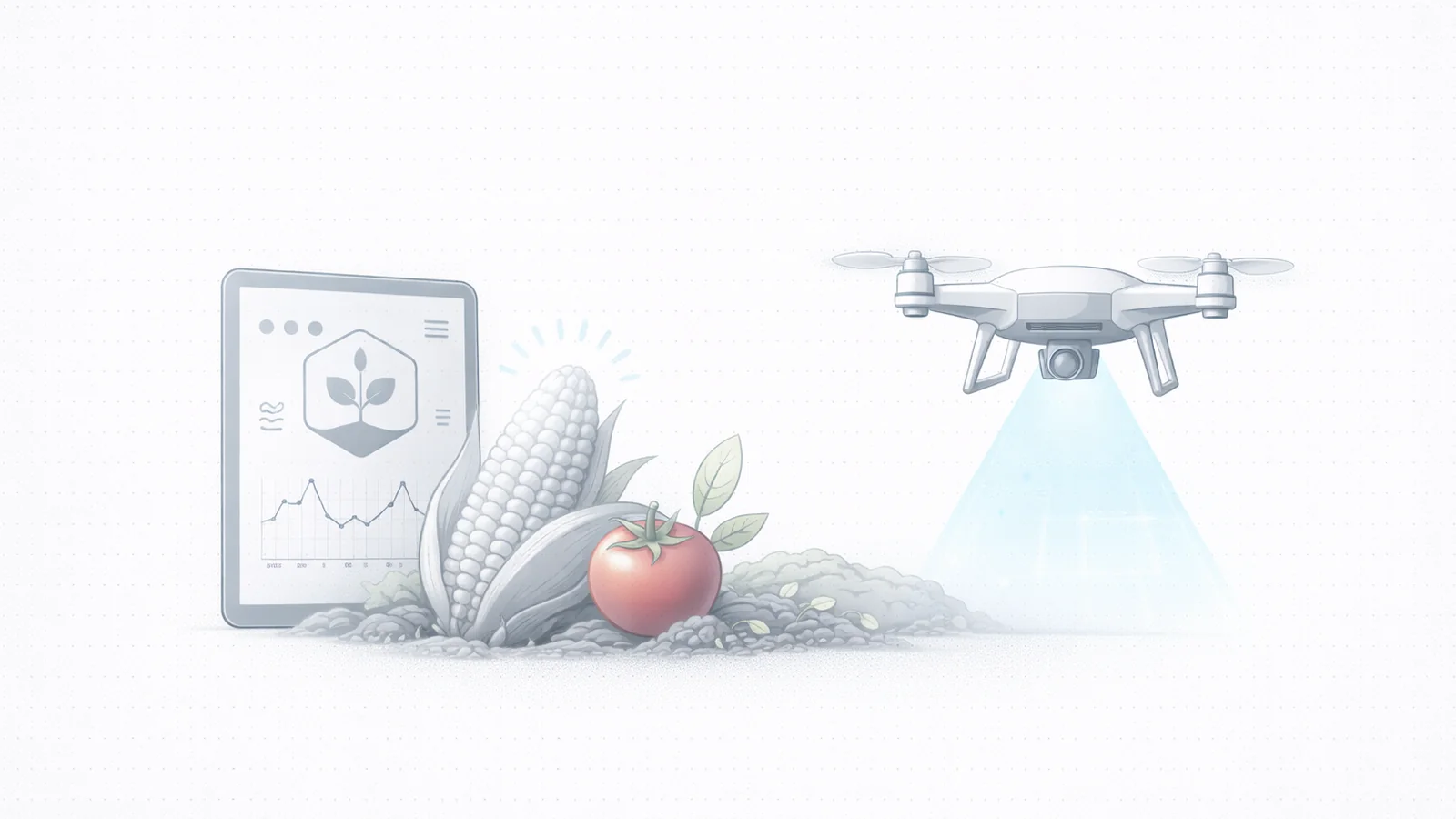
Agriculture at a Technological Turning Point
Agriculture is one of humanity’s oldest activities, yet it is now facing some of its most complex challenges. Climate change, population growth, water scarcity, soil degradation, and rising production costs are putting unprecedented pressure on global food systems. Traditional farming methods, while effective for centuries, are no longer sufficient on their own to meet modern demands.
Artificial intelligence has emerged as a powerful tool capable of transforming how food is grown, managed, and distributed. Unlike past agricultural innovations that focused mainly on machinery or chemicals, AI operates through data, prediction, and automation. It enables farmers to make decisions based on real-time insights rather than intuition alone.
The integration of AI into agriculture is not about replacing farmers but about augmenting their knowledge. From predicting crop diseases before they spread to optimizing irrigation and reducing waste, smart algorithms are reshaping farming into a more precise, efficient, and sustainable practice.
This article explores how AI is being applied in agriculture, the benefits it brings, the risks it introduces, and what the future may hold for food production in an AI-driven world.
What Artificial Intelligence Means in Agriculture
Artificial intelligence in agriculture refers to the use of algorithms and machine learning systems to analyze large datasets related to farming activities. These datasets may include weather patterns, soil conditions, satellite imagery, crop health metrics, and historical yield data.
Unlike conventional software that follows fixed instructions, AI systems learn from data. They improve their predictions over time, making them particularly useful in environments as complex and variable as agriculture. Farming conditions change constantly, and AI thrives in situations where multiple variables interact.
In practical terms, agricultural AI appears in tools such as crop monitoring systems, predictive analytics platforms, automated machinery, and decision-support software. These tools help farmers understand what is happening in their fields and what actions are likely to produce the best results.
Precision Farming and Data-Driven Agriculture
One of the most significant contributions of AI to agriculture is precision farming. Precision farming focuses on applying the right treatment at the right time and place rather than treating an entire field uniformly.
AI systems analyze data from sensors, drones, and satellites to identify variations within a field. These variations may relate to soil moisture, nutrient levels, or plant health. Based on this analysis, farmers can adjust irrigation, fertilization, and pesticide use with remarkable accuracy.
This approach reduces waste, lowers costs, and minimizes environmental impact. Precision farming also improves yields by ensuring crops receive exactly what they need to thrive.
A detailed overview of precision agriculture technologies can be found through the Food and Agriculture Organization of the United Nations: https://www.fao.org/digital-agriculture
AI-Powered Crop Monitoring and Disease Detection
Crop diseases and pests can devastate yields if not detected early. Traditionally, farmers relied on visual inspections, which are time-consuming and often detect problems only after damage has occurred.
AI has changed this process by enabling early detection through image analysis. Cameras mounted on drones or smartphones capture images of crops, which AI systems analyze for signs of disease, nutrient deficiencies, or pest infestations. These systems can detect patterns invisible to the human eye.
Early detection allows farmers to act quickly, preventing widespread damage and reducing the need for excessive chemical treatments. This not only protects crops but also supports more sustainable farming practices.
Smart Irrigation and Water Management
Water scarcity is one of the most pressing challenges facing agriculture today. Inefficient irrigation wastes resources and increases costs, while under-irrigation harms crop yields.
AI systems optimize irrigation by analyzing soil moisture data, weather forecasts, evaporation rates, and crop water requirements. These systems determine exactly when and how much water should be applied, often automating the process entirely.
Smart irrigation reduces water usage while maintaining or improving yields. It also protects soil health by preventing overwatering, which can lead to erosion and nutrient loss.
The World Bank has highlighted the role of digital technologies, including AI, in improving water efficiency in agriculture: https://www.worldbank.org/en/topic/agriculture
AI in Soil Health and Nutrient Management
Healthy soil is the foundation of productive agriculture. AI helps farmers understand soil conditions at a granular level, enabling better nutrient management.
By analyzing soil samples, satellite data, and crop performance history, AI systems identify nutrient deficiencies and recommend precise fertilizer applications. This reduces overuse of fertilizers, which can harm the environment and increase costs.
Better soil management leads to healthier crops, higher yields, and long-term sustainability. AI also helps track soil changes over time, allowing farmers to adjust practices proactively.
Autonomous Machinery and Smart Equipment
AI is also transforming agricultural machinery. Autonomous tractors, harvesters, and planting machines equipped with AI can operate with minimal human intervention.
These machines use computer vision, GPS, and sensor data to navigate fields, avoid obstacles, and perform tasks with high precision. Autonomous equipment reduces labor shortages, increases efficiency, and allows farming operations to continue around the clock.
While adoption varies by region and cost, autonomous machinery represents a significant shift in how agricultural work is performed.
Information on autonomous agricultural technology developments can be found through research initiatives supported by MIT: https://www.csail.mit.edu
Predictive Analytics and Yield Forecasting
Predicting crop yields accurately is crucial for planning, pricing, and food security. AI excels at identifying patterns across large datasets, making it ideal for yield forecasting.
By analyzing weather data, soil conditions, planting schedules, and historical yields, AI systems generate forecasts that help farmers and policymakers make informed decisions. These predictions support better supply chain planning and reduce market volatility.
Accurate forecasting also helps governments and organizations anticipate food shortages and respond more effectively.
AI and Sustainable Farming Practices
Sustainability is a growing priority in agriculture. AI contributes to sustainability by optimizing resource use, reducing waste, and minimizing environmental impact.
Smart algorithms help farmers reduce chemical inputs, conserve water, and lower greenhouse gas emissions. By making farming more efficient, AI supports both economic viability and environmental responsibility.
Organizations such as the International Food Policy Research Institute actively study how technology supports sustainable agriculture: https://www.ifpri.org
Challenges and Risks of AI in Agriculture
Despite its benefits, AI in agriculture presents challenges. High initial costs can limit access for small-scale farmers, potentially widening inequality. Data ownership and privacy are also concerns, as farming data becomes increasingly valuable.
There is also a risk of over-reliance on automated systems. Farming requires contextual understanding that technology alone cannot provide. Poor data quality or biased algorithms can lead to incorrect recommendations.
Addressing these challenges requires transparent systems, farmer education, and supportive policies that ensure equitable access.
The Role of Farmers in an AI-Driven Agricultural System
AI does not replace farmers; it reshapes their role. Farmers become data-informed decision-makers who combine experience with algorithmic insights.
Successful adoption depends on trust and understanding. Farmers must know how AI systems work, their limitations, and when human judgment should override automated recommendations.
Education and training are essential to ensure that farmers remain empowered rather than dependent.
The Future of AI and Global Food Security
As the global population continues to grow, AI will play a critical role in ensuring food security. Smarter farming systems can increase yields without expanding farmland, preserving natural ecosystems.
Future developments may include fully integrated farming platforms that manage entire operations, from planting to distribution. AI may also support climate-resilient agriculture by helping farmers adapt to changing conditions.
The long-term impact of AI on agriculture will depend on how responsibly it is developed and deployed.
Growing Food in an Intelligent Age
Artificial intelligence is transforming agriculture from a labor-intensive tradition into a data-driven science. Smart algorithms are helping farmers grow more food with fewer resources, making agriculture more resilient and sustainable.
While challenges remain, the potential benefits are profound. AI offers a path toward feeding the world while protecting the planet. The future of farming lies not in choosing between tradition and technology, but in combining both intelligently.
By Sami Hayes – AIchronicle Insights