
The Hidden Risks of Relying Too Much on Artificial Intelligence
Artificial intelligence has become one of the most influential technologies of the modern era. From smartphones and search engines to healthcare systems and financial platforms, AI is increasingly woven into everyday life. Its ability to analyze massive amounts of data, automate tasks, and provide instant answers has made it a powerful tool for individuals, businesses, and governments alike. However, as AI continues to expand its role in society, an important question arises: what happens when we rely on it too much?
While artificial intelligence offers undeniable benefits, excessive dependence on it carries risks that are often overlooked. These risks are not always technical failures or dramatic scenarios involving machines taking over the world. Instead, they are subtle, gradual changes that affect how people think, work, make decisions, and interact with one another. Understanding these hidden risks is essential if society wants to use AI responsibly without sacrificing human judgment, creativity, and autonomy.
This article explores the less-discussed consequences of overreliance on artificial intelligence, highlighting why balance, awareness, and human oversight are more important than ever.
Loss of Critical Thinking and Independent Decision-Making
One of the most significant risks of relying too heavily on artificial intelligence is the gradual weakening of critical thinking skills. AI systems are designed to provide quick answers, recommendations, and solutions. While this convenience is helpful, it can also encourage people to accept outputs without questioning them.
When individuals consistently depend on AI to make choices—such as what to read, what to buy, which route to take, or even how to solve academic problems—they may stop engaging deeply with information. Over time, this reduces the habit of evaluating sources, comparing perspectives, and reasoning independently. The brain becomes accustomed to receiving answers instead of forming them.
In educational settings, this risk is particularly concerning. Students who rely excessively on AI tools for homework, research, or note-taking may miss the opportunity to develop essential learning skills. Understanding, analysis, and synthesis are replaced with passive consumption of AI-generated content. This does not mean AI should be avoided in education, but it does mean it must be used as a support tool rather than a replacement for thinking.
Erosion of Human Creativity
Artificial intelligence can generate text, images, music, and designs at impressive speed. While these capabilities can enhance creative workflows, they also pose a risk to originality when used without restraint. Creativity thrives on experimentation, mistakes, and personal expression—qualities that cannot be fully replicated by algorithms trained on existing data.
Overreliance on AI-generated creative content may lead to uniformity rather than innovation. When creators depend too much on AI suggestions, styles begin to converge, and originality can fade. This is especially noticeable in content creation, marketing, and design, where many outputs start to resemble one another.
Human creativity is not just about producing content efficiently; it is about perspective, emotion, and lived experience. When AI becomes the dominant creative force, there is a danger that unique voices and unconventional ideas are overshadowed by algorithmic patterns. Maintaining creativity requires active human involvement, curiosity, and the willingness to go beyond what AI predicts will perform well.
Overconfidence in AI Accuracy
Another hidden risk is the assumption that AI systems are always correct. Because AI often produces confident and polished outputs, users may trust its responses without verifying them. This is especially problematic in fields where accuracy is critical, such as healthcare, law, finance, and scientific research.
AI systems can make mistakes for several reasons. They may be trained on incomplete or outdated data, misunderstand context, or produce plausible-sounding but incorrect information. When users rely on AI without cross-checking facts, errors can spread quickly and go unnoticed.
Overconfidence in AI can also lead to poor decision-making at an organizational level. Businesses that automate decisions without human oversight risk making flawed strategic choices. Ethical responsibility requires recognizing that AI is a tool, not an authority, and that human judgment must remain central in important decisions.
Bias and Reinforcement of Inequality
Artificial intelligence systems learn from data, and data reflects human society with all its imperfections. When AI is trained on biased datasets, it can replicate and amplify existing inequalities. This is one of the most serious ethical concerns associated with AI overreliance.
Bias in AI can affect hiring processes, loan approvals, facial recognition systems, and content moderation. When organizations rely too heavily on automated systems, biased outcomes may become normalized and harder to challenge. Because AI decisions often appear objective, people may not question them, even when they are unfair.
Reducing bias requires continuous monitoring, diverse data sources, and human intervention. Relying solely on AI without accountability increases the risk of systemic discrimination and social harm.
Reduced Human Interaction and Social Skills
As AI-powered systems handle more communication tasks, human interaction may decrease. Chatbots respond to customer service inquiries, virtual assistants manage schedules, and automated systems replace face-to-face interactions. While this improves efficiency, it can also weaken interpersonal skills and emotional intelligence.
Human communication involves empathy, nuance, and understanding that go beyond data analysis. Overreliance on AI-mediated interactions can make communication feel transactional rather than meaningful. This is especially concerning in environments such as education, healthcare, and mental health support, where human connection plays a crucial role.
Technology should enhance human relationships, not replace them. Maintaining strong social skills requires regular human interaction and emotional engagement that AI cannot fully provide.
Dependence on Technology and System Vulnerability
Heavy reliance on artificial intelligence increases dependence on complex technological systems. When these systems fail—due to technical issues, cyberattacks, or data corruption—the consequences can be severe. Over-automation reduces resilience by removing human backup processes.
Organizations that depend entirely on AI for operations may struggle to function when systems go offline. Individuals who rely on AI for navigation, memory, and problem-solving may feel helpless without it. This dependency creates vulnerabilities that can disrupt daily life and critical infrastructure.
Building resilient systems requires maintaining human skills alongside automation. Redundancy, training, and contingency planning are essential to prevent overdependence from becoming a liability.
Privacy Risks and Loss of Personal Control
Artificial intelligence relies on large volumes of data, much of it personal. Overreliance on AI-driven services often means increased data collection, tracking, and analysis. This raises concerns about privacy and personal autonomy.
Many users are unaware of how much data they share with AI systems or how that data is used. When people depend heavily on AI-powered platforms, they may sacrifice control over personal information without fully understanding the consequences. Data breaches, misuse, and unauthorized surveillance become greater risks.
Responsible use of AI requires transparency, informed consent, and strong data protection measures. Users must remain aware of the trade-offs involved in convenience-driven technology adoption.
Ethical Blind Spots and Responsibility Gaps
When decisions are automated, responsibility can become unclear. If an AI system makes a harmful decision, who is accountable? The developer, the organization, or the system itself? Overreliance on AI can create ethical blind spots where no one takes full responsibility.
This diffusion of responsibility is dangerous, particularly in high-impact areas such as criminal justice, healthcare diagnostics, and financial decision-making. Ethical AI use demands clear accountability structures and human oversight to ensure that decisions can be explained, challenged, and corrected.
Long-Term Impact on Human Skills and Knowledge
Artificial intelligence excels at tasks such as memorization, calculation, and pattern recognition. When humans rely too heavily on AI for these functions, they may lose proficiency over time. Skills that are not practiced tend to fade.
This long-term effect is already visible in areas such as navigation, spelling, and basic arithmetic. While technology has always influenced skill development, AI’s predictive and generative capabilities accelerate this trend. The challenge is not to reject AI, but to use it in ways that complement human abilities rather than replace them entirely.
Finding the Right Balance Between AI and Human Judgment
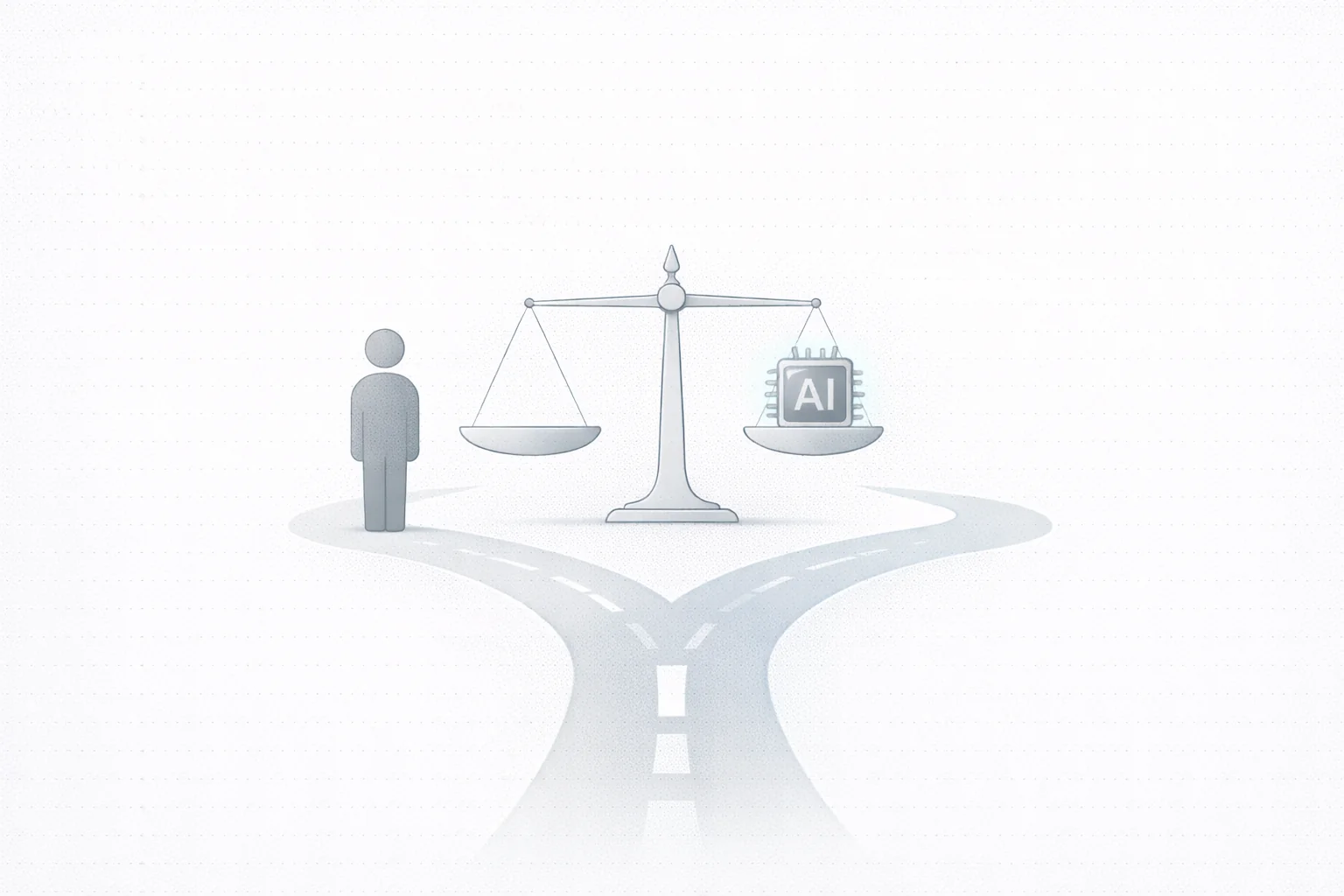
The risks of overreliance on artificial intelligence do not mean that AI should be avoided. Instead, they highlight the importance of balance. AI is most effective when used as a tool that supports human decision-making, creativity, and problem-solving.
Responsible AI use involves awareness, education, and intentional design. Users must remain engaged, question outputs, and maintain critical thinking skills. Organizations must prioritize transparency, fairness, and accountability. Policymakers must adapt regulations to protect individuals without stifling innovation.
Artificial intelligence is a powerful assistant, but it should never replace human responsibility, ethics, or judgment.
Technology Should Serve Humanity, Not Replace It
Artificial intelligence has the potential to improve lives, increase efficiency, and solve complex problems. However, when reliance becomes excessive, the hidden risks begin to surface. Loss of critical thinking, erosion of creativity, bias, privacy concerns, and weakened human connection are not distant threats—they are gradual changes already taking place.
The future of AI should not be defined by blind dependence, but by thoughtful integration. By recognizing the limits of artificial intelligence and valuing human skills, society can ensure that technology remains a tool for empowerment rather than a source of unintended harm.
The goal is not to choose between humans and machines, but to build a future where both work together responsibly, ethically, and wisely.
By Sami Hayes – AIchronicle Insights

Pingback: The High Cost of Convenience: AI Fatigue and the Rise of Cognitive Bankruptcy in 2026 - AIchronicle
Pingback: AI Fatigue in 2026: Cognitive Bankruptcy
Pingback: Who Controls the Chips Controls AI’s Future